A manageable everyday budget
Broadly comparable to France: restaurants and fuel are noticeably cheaper, while housing is more in demand. A couple lives comfortably on €2,000 to €3,000 per month.
Advantageous dining & fuel costs
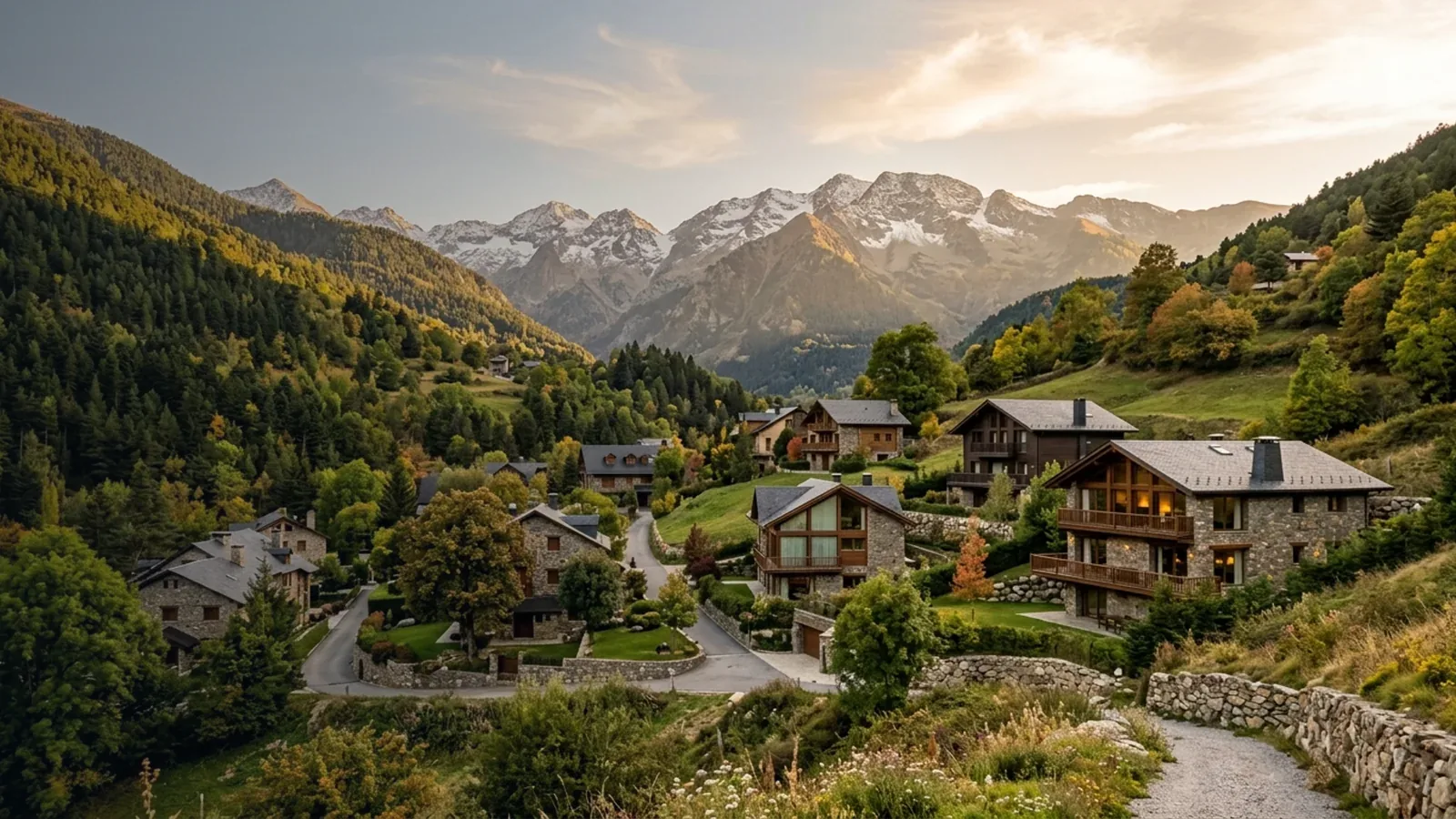
Far more than a light tax burden: a rare quality of life. Outstanding safety, nature and skiing on your doorstep, high-quality healthcare, trilingual schools — in the heart of the Pyrenees, 3 h from Barcelona.
Living in Andorra, in brief
Andorre Gestoria — French-speaking tax and wealth advisory firm, Canillo (RLG CAPITAL, SL). Up to date as of 15 October 2026.
 Andorra
The tax advantage attracts; the lifestyle keeps people here. Safety, nature, quality healthcare, and the ease of everyday life make Andorra a place where people truly put down roots — not just a tax address.
One of the safest countries in the world: an ideal environment for families who value tranquillity.
Grandvalira, hiking, mountain biking, Caldea thermal baths: the mountains and fresh air are part of everyday life, year-round.
Catalan, Spanish, and French: you feel at home quickly, just 3 h from Barcelona and Toulouse.
Three topics that determine whether an expatriation truly succeeds. Here is what you need to know — and we support you through every one of them.
Broadly comparable to France: restaurants and fuel are noticeably cheaper, while housing is more in demand. A couple lives comfortably on €2,000 to €3,000 per month.
Advantageous dining & fuel costsThe CASS reimburses a large share of medical costs for contributors, topped up by supplementary insurance. French-speaking medicine and a modern hospital (Meritxell): a reputable and accessible system.
CASS + supplementary insuranceThree systems coexist: Andorran, French (state-funded and free) and Spanish. Your children grow up naturally trilingual.
French system availableThe lifestyle is best enjoyed once the formalities are properly under way. Six subjects to settle, in order — each one links to our detailed guide.
Living in Andorra requires a residence authorisation. Active residency concerns those who work there: an employee hired under the general quota — 900 authorisations until 30 April 2027 (Decree 388/2026) —, the director of a company in which they hold more than 34%, or a self-employed person practising a regulated profession. Passive residency is for those who live off their income: an investment of €1,000,000 in Andorran assets (or €400,000 in the Housing Fund), a non-refundable contribution of €50,000 to the AFA (+€12,000 per dependant), income above 300% of the annual minimum wage and at least 90 days of presence a year. For 2026, Decree 74/2026 reserves 163 places for passive residency.
The permit is not enough: Andorran tax residency requires more than 183 days of presence in the calendar year, or the centre of your activities or economic interests in Andorra (Law 5/2014, art. 8). On the French side, you also need to fall outside the criteria of article 4 B of the French tax code; the 2013 tax treaty settles cases of dual residency. The details are on our tax residency page and in our guide on how to prove your tax residency.
The job market is narrow and concentrated in retail, tourism, banking, construction and public administration: a partner’s job needs preparing before the move. Employees must present a level A1 Catalan diploma at the first renewal of their authorisation, then A2 at the second (Law 6/2024). Contracts, permits and rights are detailed in our guide to working in Andorra.
Employees and the self-employed contribute to the CASS, which reimburses 75% of outpatient care and 90% of hospital care within the “via preferent” (with a referring doctor), 33% outside it. Passive residents take out private health insurance; a retiree can, under certain conditions, remain covered by their home scheme thanks to the 2000 Franco-Andorran social security agreement. Everything is explained in our guide to healthcare and social security.
Housing is scarce: it is the first subject to settle. A foreign investor — including a resident who has lived there for less than three years — may only acquire one single-family house or two apartments, related parties included, and pays the foreign real estate investment tax: 6% on a first property, 10% beyond that (Law 2/2026), with a 90% reduction for a home let as a primary residence at an affordable rent for at least ten years. See our guides to renting a home and to buying in Andorra.
Once you are a tax resident: IRPF from 0 to 10% (0% up to €24,000 of income), IGI at 4.5% on consumption, and no wealth tax or inheritance tax. The IRPF return is filed between 1st April and 30 September (Law 5/2014, art. 55). Estimate your situation with our tax simulator and our guide to Andorran taxation.
Before committing, also read about the real downsides of living in Andorra and, to get support, our criteria for choosing the right gestoria in Andorra.
An indicative breakdown for a couple, excluding property purchase. Figures vary depending on lifestyle and location.
| Expense (couple, monthly) | Indicative budget |
|---|---|
| Housing (rental) | €1,200 – €2,000 |
| Utilities | €100 – €150 |
| Food | €400 – €700 |
| Transport | €50 – €100 |
| Health insurance | €100 – €200 |
| Leisure | €150 – €300 |
| Approximately €2,000 to €3,000 per month to live comfortably, excluding property purchase. | |
What the numbers cannot capture: serenity, fresh mountain air, and proximity to two major cities.
Near-zero crime and a constant sense of security: one of the safest environments in the world to live and raise a family.
Peace of mind every daySkiing at Grandvalira, hiking, mountain biking, Caldea thermal baths, around 300 sunny days a year: the great outdoors is part of daily life.
All seasonsAround 2 h 30 – 3 h by road to Barcelona and Toulouse and their international airports. A trilingual population where French speakers feel right at home.
Europe within easy reachA couple lives comfortably on €2,000 to €3,000 per month (excluding property purchase), depending on lifestyle and the location of their accommodation.
Broadly comparable: restaurants and fuel are noticeably cheaper, while housing — in high demand — tends to be more expensive. The light tax burden more than offsets the difference.
The CASS (social security) reimburses a large share of medical costs for contributors, topped up by supplementary insurance. The system is well regarded and French-speaking, with a modern hospital. Passive residents take out private health insurance.
Three systems coexist: Andorran, French (state-funded and free, under convention) and Spanish. Children naturally become trilingual — a lifelong asset.
Yes, among the safest in the world: crime is virtually non-existent. This is one of the most compelling reasons families choose to settle here.
Allow around 2 h 30 to 3 h by road to Barcelona or Toulouse and their international airports: Europe remains very accessible in day-to-day life.
Catalan is the official language, but French and Spanish are widely spoken. Employees must nevertheless present a level A1 Catalan diploma at the first renewal of their residence and work authorisation, then A2 at the second (Law 6/2024).
It depends on your status: at least 90 days a year for passive residency; a main presence for active residency, with at least 183 days a year for renewing the authorisation. To be a tax resident, you need more than 183 days of presence in the calendar year, or to have the centre of your economic interests there.
Yes, but the salary remains taxable in France, where the work is carried out, and a main activity carried out in France ties your tax domicile to France (French tax code, art. 4 B). The tax treaty does not provide for a cross-border workers’ regime.
Yes, most often through passive residency. Private pensions are in principle taxable in Andorra (IRPF from 0 to 10%), although France may tax any portion that is exempt there (tax treaty, art. 25); health cover comes through the 2000 social security agreement or private insurance.
Ready to take the next step? Discover active residency, passive residency, or how to invest in Andorran real estate.