

In brief: Crypto taxation in Andorra.
- Is merely holding cryptocurrency taxed in Andorra? No. Andorra has no wealth tax: holding cryptocurrencies, even in large amounts, triggers no taxation.
- How are staking and mining taxed? Law 24/2022 governs digital assets, and the taxation of individuals falls under IRPF, capped at 10%.
- What must you declare when leaving France with a crypto portfolio? Article 167 bis of the French tax code targets taxpayers holding more than €800,000 in securities on the day of departure, with reporting obligations in the year of the transfer.
Short answers by Andorre Gestoria, a French-speaking tax and wealth advisory firm in Canillo (RLG CAPITAL, SL). Details, figures and sources in the article — updated 15 October 2026.
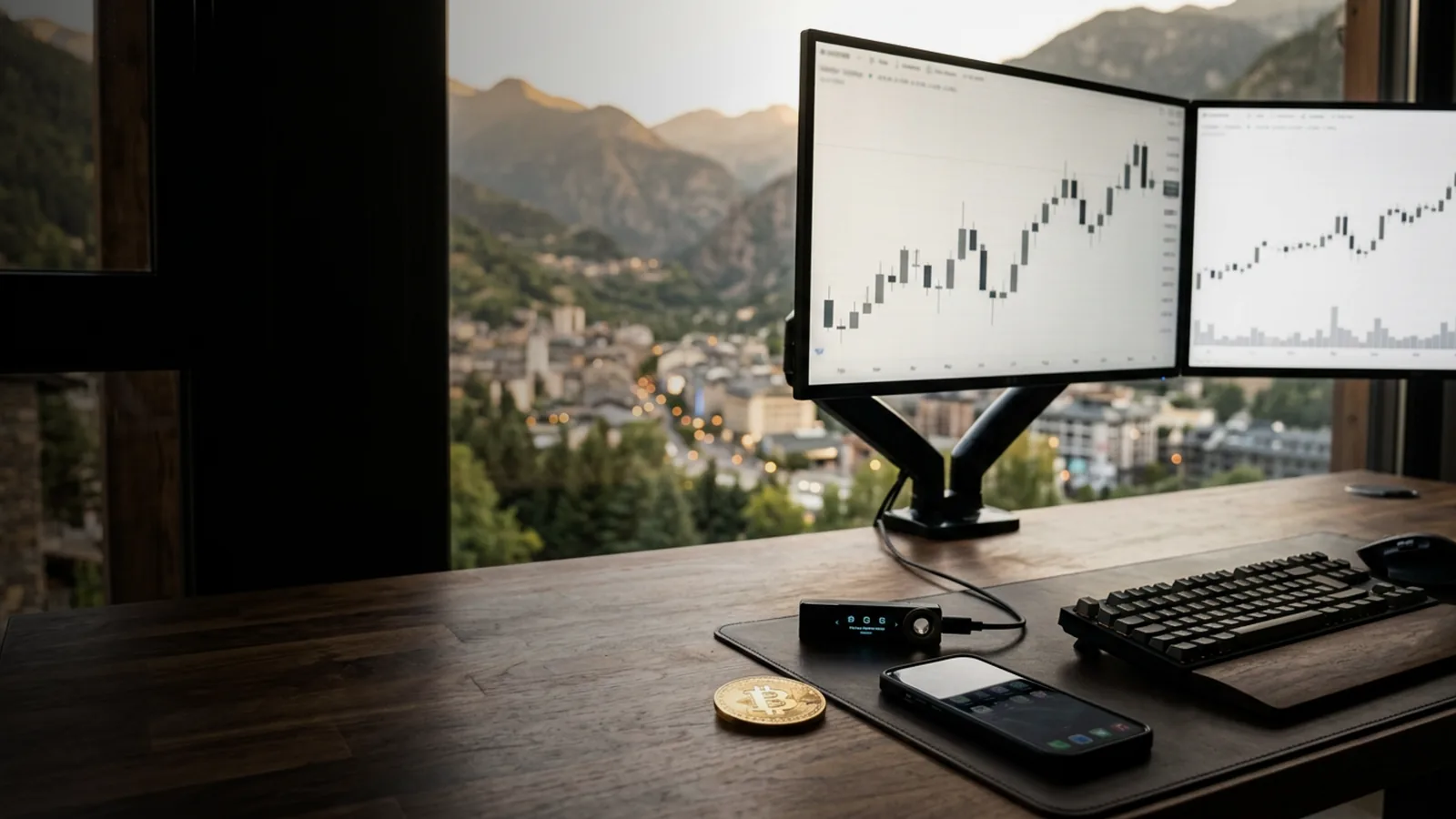
For a cryptocurrency holder, the difference in taxation between countries can quickly run to tens of thousands of euros. Andorra has established itself as one of the most attractive jurisdictions in Europe in this respect — not through opacity, but through light taxation combined with a solid legal framework. This guide gives you the complete picture: applicable rates, the gap with France in figures, preparing your departure, staking and NFTs, and the banking relationship for funds of crypto origin.
How Andorra taxes your crypto capital gains
Capital gains realised on the disposal of cryptocurrencies by an Andorran tax resident are taxed under personal income tax (IRPF), at 10 % maximum — and 0 % on the first €3,000, thanks to the savings-base allowance. Mere holding is not taxed (no wealth tax), and only the realisation of a gain triggers taxation. By comparison, France applies 31.4 % (single flat-rate levy, 2026 rate). The gap speaks for itself — and our tax simulator lets you measure it on your own figures.
The gap in figures: two concrete examples
Let us take two disposal scenarios carried out by an individual — on one side a French tax resident subject to the single flat-rate levy, on the other an Andorran tax resident taxed under IRPF.
| Capital gain realised | Tax in France (31.4 %) | Tax in Andorra (10 % max) | Saving |
|---|---|---|---|
| €100,000 | €31,400 | ≤ €10,000 | more than €21,000 |
| €500,000 | €157,000 | ≤ €50,000 | more than €100,000 |
| Indicative 2026 calculation: France at the single flat-rate levy of 31.4 % (12.8 % income tax + 18.6 % social levies); Andorra at IRPF capped at 10 % (savings base, after a €3,000 allowance). Your exact situation is confirmed during the personalised assessment. | |||
On a capital gain of €500,000, the gap exceeds €100,000. And this gap recurs with every cycle: an investor who realises gains regularly finds it again year after year. That is what makes Andorran tax residency a structural choice, rather than a mere one-off optimisation.
Investor or trader: the distinction that matters
Not all profiles are treated alike. A long-term investor falls under capital gains treatment (up to 10 %). A habitual trader, who operates frequently, in an organised way and at high volume, may see the activity reclassified as business income — still within the 10 % ceiling, but with its own rules. The tax authority looks at the frequency of transactions, volumes and intent. Framing your profile properly from the outset avoids unpleasant surprises: this is where our advice comes in. We have also devoted a dedicated page to traders in Andorra, which details the regime that applies to active operators, crypto included.
Staking, mining, NFTs: what Law 24/2022 says
The Principality has chosen to regulate rather than ignore: Law 24/2022 on the digital representation of assets gives a legal framework to digital assets and blockchain technology — token issuance, service providers, business projects. It is this foundation that makes the Andorran ecosystem clear for investors and banks alike.
On the tax side, the guiding principle is simple to remember: everything taxable for an individual falls under IRPF, capped at 10 %. The finer classification, on the other hand, is analysed case by case:
- Staking: the rewards received are economically akin to a return on capital. Depending on the arrangements (delegated staking, direct validation, platform), the classification adopted may differ — income, or a capital gain at the time of disposal.
- Mining: a structured mining activity, with dedicated hardware and power consumption, leans towards business income, where appropriate through a company subject to corporate tax at 10 %.
- NFTs: an occasional sale by a collector falls in principle under capital gains; habitual creation and sale resemble a business activity.
None of these cases can be settled with a ready-made answer: the treatment depends on the exact nature of the transactions, their frequency and their organisation. The good news is that the 10 % ceiling applies whatever the classification adopted — so the challenge is to secure the file, not to avoid a confiscatory rate.
A clear legal framework, transparency embraced
Andorra does not improvise: in addition to Law 24/2022, the Principality applies automatic exchange of information, extended to digital assets. This transparency is an asset, not a constraint. It makes your situation bankable, recognised and lasting — a world away from the fragile structures of the past. An Andorran resident whose crypto file is clean and documented has nothing to fear from this environment: they benefit from it.
Preparing your departure from France with a crypto portfolio
Becoming an Andorran tax resident means ceasing to be a French tax resident — a transition that can be organised, and one that is very easy to anticipate with a well-prepared file. The point to know is article 167 bis of the French tax code: when tax domicile is transferred outside France, taxpayers whose holdings of securities, investments and company shares exceed €800,000 (or who hold at least 50 % of a company) see their unrealised gains on those securities fall within the scope of a departure tax.
Two clarifications change everything for a cryptocurrency holder:
- The scope: the mechanism targets company shares, investments and securities — crypto-assets held directly are not expressly covered. The boundary calls for careful analysis, particularly where the portfolio is held through a company or backed by financial products: this is precisely the kind of point we settle upstream.
- Payment deferral: the law provides for an automatic deferral, without guarantees, in the event of a move to an EU or EEA State, or to a State that has concluded with France an administrative assistance agreement and a recovery assistance agreement. Andorra exchanges information with France, but no recovery-assistance clause binds them (BOFiP, BOI-ANNX-000508): the deferral is therefore not automatic. It must be requested — form 2074-ETD filed within the 90 days before departure, a tax representative in France and guarantees. We coordinate the analysis with your French advisers to lock this point down for your exact situation.
In practice, timing makes the difference: departure date, chronology of disposals, documentation of positions on the day of the transfer. Handled well, this step results in a smooth transition — and in taxation of 10 % maximum on the gains realised once your Andorran tax residency is established.
Andorran banks and funds of crypto origin
It is the question every serious holder asks: what happens to my funds once converted? The Andorran banking centre, solid and consolidated, welcomes capital of crypto origin — subject to a rigorous compliance process, aligned with international anti-money-laundering standards. This rigour is a strength: it protects the reputation of the financial centre, and therefore yours.
In practice, the bank examines the traceability of funds: origin of the capital invested, transaction history on exchange platforms, wallet statements, previous tax returns. A well-documented file opens doors — we see it every time. Our role is precisely to build this file with you before the first bank meeting: acquisition chronology, exchange records, consistency between the flows and your tax-filing history. Presented in this way, crypto wealth is no obstacle to banking: it is wealth like any other, with its supporting documents.
Andorra vs France: the crypto gap
| Criterion | Andorra | France |
|---|---|---|
| Capital gains on disposal | 10 % max | 31.4 % (flat rate) |
| Mere holding | Not taxed | Not taxed |
| Wealth tax | None | None on crypto |
| Dedicated legal framework | Law 24/2022 | Evolving |
| First €3,000 of gains | 0 % (allowance) | 31.4 % from the 1st € |
| Indicative 2026 rates for a tax resident. Classification as investor or trader affects the applicable regime. | ||
Key takeaways
- Crypto capital gains: 10 % maximum, after a €3,000 allowance
- On a €500,000 capital gain, a gap of more than €100,000 with France
- No tax on mere holding or on wealth
- Dedicated legal framework: Law 24/2022 on digital assets
- Leaving France: article 167 bis of the French tax code is very easy to anticipate with a well-prepared file
- Banks: a documented crypto file opens doors
Do you hold or trade crypto and are you considering Andorra? We structure your tax residency and, where needed, your company, securing your crypto position from the outset — start by quantifying your case with our tax simulator.