




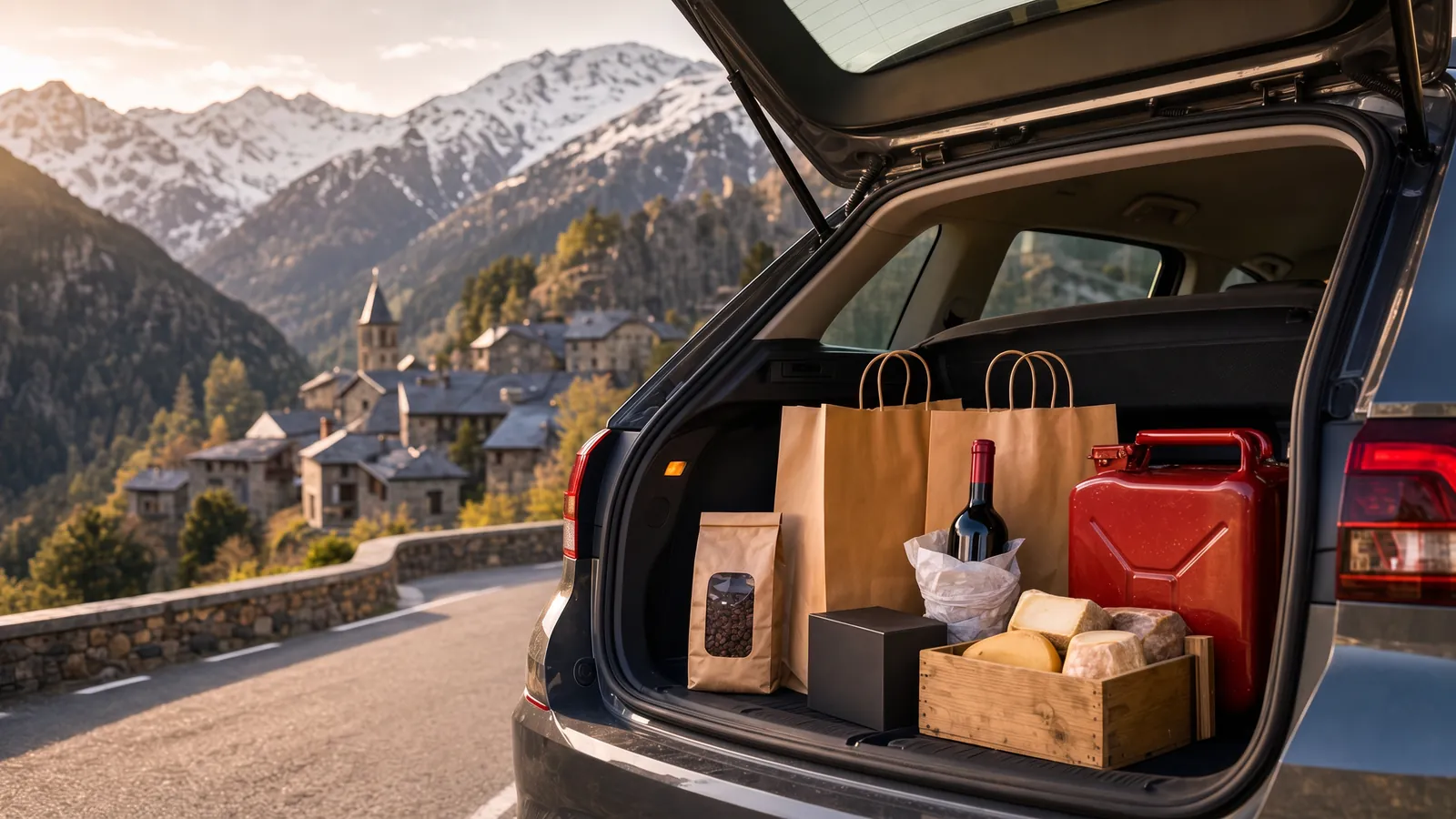
The Andorra customs allowances in brief
- Tobacco (aged 17 or over): 300 cigarettes, a carton and a half, or 150 cigarillos, or 75 cigars, or 400 g of smoking tobacco.
- Alcohol (aged 17 or over): 5 litres of still wine, plus 1.5 litres of drinks over 22° or 3 litres of drinks of 22° or less. Spain also allows 16 litres of beer; France has no dedicated beer line.
- Shopping: €900 per traveller aged 15 or over (€450 under 15), including up to €300 of food (€150 under 15).
- Fuel: the vehicle’s normal tank, plus one can of up to 10 litres.
- The allowances are per person — never per car — and cannot be pooled for a single item. Above them, duty and tax are charged on the whole value, with no deduction.
Sources: French customs (Andorra pages and the brochure “Voyagez tranquille en Andorre”), the EC–Andorra agreement of 28 June 1990, the Spanish Tax Agency (Agencia Tributaria, updated 23 September 2026), the French customs code as recodified on 1 May 2026 (Ordonnance n° 2026-265 of 8 April 2026). Correct as at 28 September 2026.
Every weekend, the queues lengthen at both ends of the Principality: south towards La Farga de Moles and Barcelona, north towards Pas de la Case and Toulouse. The explanation fits in a few figures: IGI, Andorra’s indirect tax, sits at a general rate of 4.5 %, against 21 % VAT in Spain and 20 % in France. But what you buy freely in Andorra is not freely brought home: the Principality belongs to neither the European Union nor its fiscal territory, and every return crossing is a customs crossing. The allowance that applies is set by the country you are entering, not by Andorra — both derive from the same 1990 customs agreement with the European Community, so the figures are almost identical, and we flag the handful of differences as we go. If you are travelling on beyond the EU afterwards — home to the United Kingdom, say — your destination country’s own allowance applies once you arrive there. Established in Andorra, we have taken every figure below from its official source, French or Spanish.
The Andorra duty-free allowance, in full
Here, category by category, is what a traveller can bring back from Andorra into Spain or France without declaring or paying anything. These allowances are specific to Andorra and far more generous than for other non-EU countries: €900 of shopping instead of €300–430, 300 cigarettes instead of 200 — the product of a specific agreement between the EU and the Principality, not the general third-country regime. Spain and France apply almost exactly the same figures; where they part company, the notes column says so.
| Product | Allowance per person | Notes |
|---|---|---|
| Cigarettes | 300 | 15 packs of 20, a carton and a half |
| or cigarillos | 150 units | Instead of cigarettes |
| or cigars | 75 units | Instead of cigarettes |
| or smoking tobacco | 400 g | Rolling or pipe tobacco |
| Still wine | 5 L | Non-sparkling, on top of the drinks below |
| Spirits over 22° | 1.5 L | Whisky, rum, vodka, gin, pastis… |
| or drinks of 22° or less | 3 L | Port, vermouth, muscat, sparkling wine… |
| Beer | Spain only: 16 L | No dedicated line in France; see below |
| Perfume | 75 ml (75 g in Spain) | A 100 ml bottle exceeds it |
| Eau de toilette | 375 ml (37.5 cl in Spain) | On top of the perfume allowance |
| Coffee | 1 kg | Or 400 g of extracts and essences |
| Tea | 200 g | Or 80 g of extracts and essences |
| Dairy | Cheese 4 kg · butter 1 kg | Fresh/liquid milk 6 kg (6 L in Spain), condensed 3 kg, powdered 2.5 kg |
| Meat | 5 kg | Within the food value limit |
| Sugar and sweets | 5 kg | Same rule |
| Food (value) | €300 | €150 under 15; combined value of all food |
| Other goods (value) | €900 | €450 under 15: clothing, electronics, leather goods… |
| Fuel | Tank + 10 L | One spare can, 10 litres maximum |
| Quantity allowances reserved for travellers aged 17 or over. Sources: French customs and the Spanish Agencia Tributaria, both for travellers arriving from Andorra. Fuel follows the general third-country rule. | ||
How many cigarettes can you bring back from Andorra?
A carton and a half per adult. The allowance is 300 cigarettes, or 15 packs of 20 — a standard carton holds 200. It only benefits travellers aged 17 or over: a 15- or 16-year-old still gets the full €900 shopping allowance, but no cigarette allowance at all. A couple therefore comes home with three cartons at most — and so does a family with two children under 17.
Per person, never per car. Nothing sets a quantity “per vehicle”, whatever many online searches suggest. At a check, customs weighs the quantity carried against the number of eligible travellers present: three adults, 900 cigarettes — no more, however large the boot.
Cigarettes or rolling tobacco? The four categories — cigarettes, cigarillos, cigars, smoking tobacco — are alternatives, not add-ons. For other non-EU countries French customs accept a “proportional assortment” (half in cigarettes, half in tobacco, say); for Andorra that would mean 150 cigarettes and 200 g of tobacco. Nothing is specified here, so the prudent reading is never to exceed 100 % in total.
What the saving is worth
Tobacco prices are regulated in all three countries: homologated retail prices in France, retail prices published by the Comisionado para el Mercado de Tabacos in Spain, and minimum retail prices set by the Govern in Andorra. On the full allowance of 15 packs:
| Pack of 20 | Andorra | Spain | France | 15 packs: Andorra / Spain / France | Saving |
|---|---|---|---|---|---|
| Marlboro Red | €4.845 | €6.25 | €13.50 | €72.68 / €93.75 / €202.50 | ≈ €21 vs Spain ≈ €130 vs France |
| Andorra: minimum retail price list published by the Govern d’Andorra (September 2026 version); shops may charge more, never less. Spain: Comisionado para el Mercado de Tabacos, BOE Resolución of 5 December 2025, in force since 6 December 2025. France: homologated retail price since 1 January 2026, unchanged on 1 September. | |||||
The Andorra–France gap tops €125 per adult, the Andorra–Spain gap about €21 — exactly why the 300-cigarette line is so closely watched. Beyond it, the saving evaporates: declaring the excess is legal but rarely worthwhile, as you then pay the VAT and excise of the country you enter; not declaring it risks confiscation and a fine on the value of the goods, set out below for each country.
The Andorra alcohol allowance: how much per person?
The alcohol allowance combines two separate pots, again reserved for travellers aged 17 or over. The first, 5 litres, covers still wine — non-sparkling: six 75 cl bottles (4.5 litres) fit inside it, a seventh does not. The second is a choice: either 1.5 litres of drinks over 22° — whisky, rum, vodka, gin, pastis — or 3 litres of drinks of 22° or less — port, vermouth, muscat, light liqueurs, sparkling wine.
- Two 70 cl bottles of whisky: 1.4 litres, inside the allowance. A third bottle: 2.1 litres, over it.
- Champagne, cava and crémant are not still wine: they come out of the 3 litre allowance for drinks of 22° or less, not the 5 litre wine allowance.
- Beer is where the two borders part company. Spain allows 16 litres in its own right; France has no dedicated beer line, so the prudent reading is to count it within the 3 litres of drinks of 22° or less — nine 33 cl cans.
- Bottled pastis is an ordinary spirit, not to be confused with aniseed extracts (concentrates for home-made aniseed drinks), which French customs class as prohibited.
Perfume, coffee, tea and food: the other limits
Perfume. France caps perfume at 75 ml and eau de toilette at 375 ml; Spain expresses its allowances as 75 g of perfume and 37.5 cl of eau de toilette (aguas de tocador). The trap is the same everywhere: most perfumery bottles hold 100 ml. Eau de parfum, being more concentrated, is prudently counted against the smaller perfume allowance — so a 100 ml bottle exceeds it.
Coffee and tea. 1 kg of coffee (or 400 g of extracts and essences) and 200 g of tea (or 80 g of extracts), per traveller aged 17 or over — the same in Spain and France.
Food. Food obeys a double limit in both countries: a combined value of €300 per traveller aged 15 or over (€150 under 15), and maximum quantities for certain products — 4 kg of cheese, 1 kg of butter, 6 kg of fresh or liquid milk, 3 kg of condensed milk, 2.5 kg of powdered milk, 5 kg of meat, 5 kg of sugar and sweets. Both ceilings apply together: four kilos of a fine cheese can reach the value limit before it reaches the weight limit.
The €900 allowance and the pooling trap
Anything outside a quantity allowance — clothing, footwear, electronics, watches, leather goods, toys — falls under a value allowance of €900 per traveller aged 15 or over, €450 under 15. Two rules turn a good deal into a bad surprise.
- No pooling. Several travellers’ allowances cannot be added together for a single item: a €1,400 computer stays a €1,400 computer, even carried home by a couple with €1,800 of allowance between them. Parts of one set carried together — a home cinema, the components of a computer — count as a single item, whatever the number of invoices.
- No deduction. Beyond the allowance, duty and tax fall on the whole value, not just the excess. Thanks to the EU–Andorra customs union, industrial goods carry no customs duty at all, so the bulk of the bill is VAT — 20 % in France, 21 % in Spain — plus excise where alcohol, tobacco or fuel is involved. A €1,000 camera declared at the border therefore costs about €200 (France) or €210 (Spain) of VAT, not 20–21 % of the €100 that exceeds the allowance.
- Approval marking into Spain. Spanish customs additionally require mobile phones, radio transmitters and bicycles to carry the marking that shows they are approved (homologados) — worth checking before you travel if you are bringing one south.
Keep your receipts: they establish the declared value. For valuable equipment of your own — laptop, camera, phone — French customs issue a free carte de libre circulation, valid for ten years, so you need not prove on every crossing that it was not bought in Andorra.
Fuel: a full tank plus 10 litres
The rule is the same whichever border you use, since it derives from the general treatment of third countries: the fuel held in the vehicle’s normal tank, plus one spare can of up to 10 litres. An extra tank fitted to the vehicle does not count, and the can itself must be designed for carrying fuel and sealed shut.
The price gap is wide this autumn. On 15 September 2026, diesel sold at €1.677 a litre and unleaded 95 at €1.685 in Andorra — about 70 cents less than in many French filling stations, where prices ran past €2, helped by a temporary cut to Andorran fuel taxation since July. Over a 50 litre tank, the saving against France runs to nearly €35; the spare can adds about €7 more.
Border controls and penalties: France and Spain
At the border, the obligation to declare what you are carrying is the rule; the allowance is only the exception to it. Stay inside the limits and you cross without formality. Beyond them, two situations are worlds apart:
- You declare the excess: you pay the duty and tax due — VAT, and excise for alcohol, tobacco or fuel. Entirely legal, and for tobacco rarely worthwhile.
- You do not declare it: that is a customs offence, and for undeclared tobacco it is treated as smuggling in both countries.
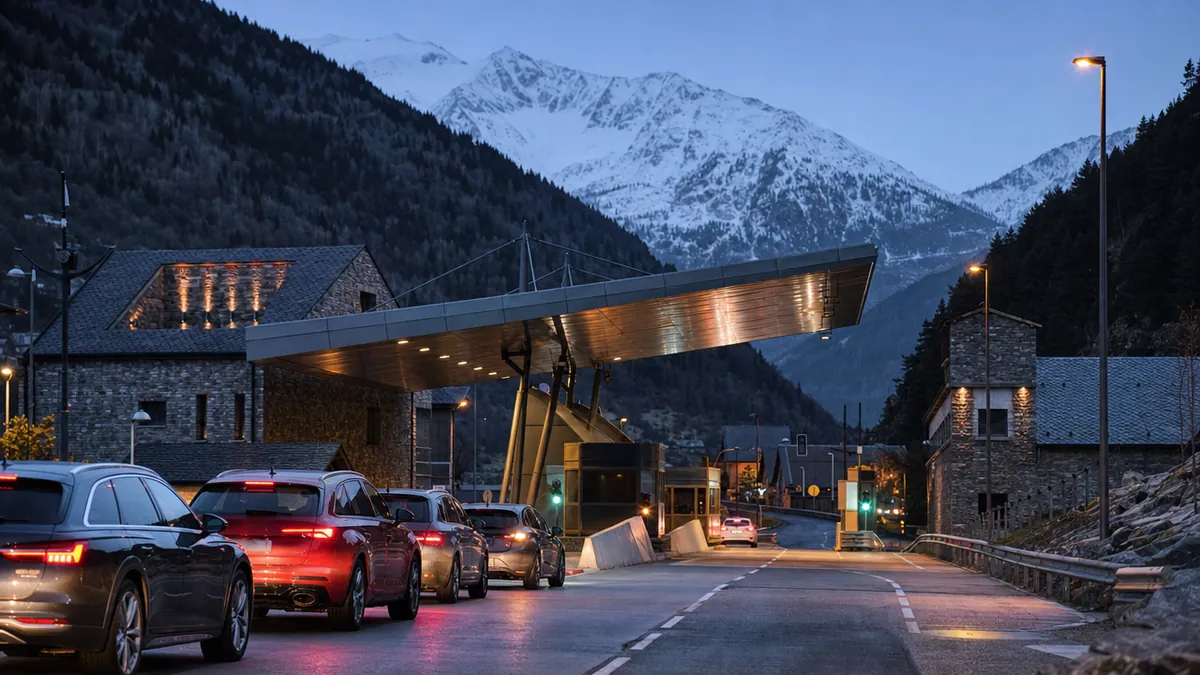
France: a fully renumbered customs code since 1 May 2026
Since 1 May 2026 the French customs code has been recodified (Ordonnance n° 2026-265 of 8 April 2026) — the first overhaul since 1948, changing no substance but renumbering every article: pages still citing “article 414” are quoting a repealed text.
| Rule | Old code | Since 1 May 2026 |
|---|---|---|
| Smuggling and importing tobacco products without declaring them: three years’ imprisonment, a fine of twice the value | Art. 414 | Art. L. 513-1 |
| Confiscation of the goods and the means of transport used | Art. 414 | Art. L. 514-4 |
| Settlement with the customs authorities | Art. 350 | Art. L. 613-2 |
| Official concordance table between the old and new customs codes (Légifrance, Journal officiel of 11 April 2026). | ||
The new article L. 513-1 is explicit: “La contrebande et l’importation ou l’exportation sans déclaration de marchandises prohibées ou de produits du tabac sont punies de trois ans d’emprisonnement et d’une amende de deux fois la valeur de l’objet de fraude.” In English: smuggling and the undeclared import or export of prohibited goods or tobacco products are punishable by three years’ imprisonment and a fine of twice the value of the goods. For a modest excess, customs may offer a settlement: the case closes on payment of a sum and surrender of the goods, without prosecution — a power of the administration, not a right of the traveller. The flat “per-carton” fines seen online rest on no published legal basis.
Spain: Ley Orgánica 12/1995 on smuggling
Spain treats customs fraud as smuggling (contrabando) under Ley Orgánica 12/1995. Undeclared tobacco worth €15,000 or more is a criminal offence (delito); below that it is an administrative infringement, with a fine of 200–300 % of the value where that is under €1,000, and a minimum fine of €2,000 for tobacco. The goods are confiscated (comiso) in every case.
For goods other than tobacco, the infringement is minor below €37,500 of value: a fine of 100–150 %, minimum €500. In both countries, declaring the excess and paying what is owed — VAT plus any excise — stays entirely legal; it is silence at the border that turns a purchase into an offence.
Cash. €10,000 or more — cash, cheques or bearer securities — must be declared on both borders: to French customs (even split between household members) via the DALIA service, to Spanish customs in person or electronically. Pets. Dogs, cats and ferrets need identification, rabies vaccination and proof of it — a European pet passport for France, a vet certificate or pet passport for Spain, which caps the number at five. Prohibited goods. Narcotics, counterfeits and CITES-protected species are banned on both sides; France also bans aniseed extracts (bottled pastis is unaffected), and Spain’s red channel further covers weapons, cultural goods, medicines beyond personal use and plants needing a phytosanitary certificate.
Residents and future residents: what applies to you
You live in Andorra. The allowances above apply to every traveller entering Spain or France from the Principality, whatever their residence: an Andorran resident visiting family in Toulouse or Barcelona brings back the same 300 cigarettes and €900 of shopping as anyone else, no more. The French carte de libre circulation helps if you cross often with your own equipment.
One advantage runs the other way. Andorran residents can reclaim Spanish VAT on non-commercial purchases made in mainland Spain or the Balearics, taken out of the EU in personal luggage within three months. At the till, show proof of identity and residence outside the EU and ask for the invoice and the electronic refund document (DER); then validate it at the “DIVA” kiosk at La Farga de Moles, goods and invoices to hand. The shop or an AEAT-approved agent then pays the refund.
You are moving to Andorra. Relocating is a different regime: Andorran Law 33/2012 admits personal property — furniture, personal effects, household equipment — free of duty and tax, provided you lived at least twelve consecutive months outside Andorran customs territory and have owned the goods for at least six months. Alcohol, tobacco and commercial vehicles are excluded. Arrange this through your active residence or passive residence file, well before the removal van reaches the border.
You are leaving Andorra for the EU. The relief runs in reverse too: EU transfer-of-residence relief brings personal property back free of duty and tax if you lived over twelve months outside the EU, owned and used the goods for over six months, declare them within twelve months of settling (in France, form Cerfa n° 10070*02), and do not sell, let or lend them for twelve months. Alcohol, tobacco and professional vehicles remain excluded.
Why is Andorra so much cheaper?
Three levers explain the gap. IGI, Andorra’s indirect tax, applies at a general rate of 4.5 %, against 20 % French and 21 % Spanish VAT — our guide to IGI sets out the rates and exemptions in full. Excise duty on tobacco, alcohol and fuel runs far below either neighbour’s. And tobacco follows a regime of its own: minimum retail prices set by the Govern and revised in step with Spanish increases — entry-level tobacco rose by about 20 % in early 2026 to keep pace.
And tomorrow? The association agreement between Andorra and the EU, approved by the Council in July 2026, is due to be signed in Brussels on 19 October 2026, then needs the European Parliament’s consent, a referendum in Andorra, and ratification by the Consell General by a two-thirds majority. Until it takes effect, nothing changes for travellers: the allowances stay those in this guide, which we will update once the new text applies. The rest of the year’s changes are gathered in our guide to the 2026 reforms.
Pitfalls to avoid
- Counting by car. The allowances are individual: the size of the boot creates no entitlement.
- Letting teenagers carry the tobacco. Under 17, the tobacco and alcohol allowance is nil.
- Adding allowances together for one purchase. A €1,200 television is not shared between two travellers.
- Filing champagne under wine. Sparkling wines are not still wine.
- Buying a 100 ml bottle of perfume thinking it fits the 75 ml (or 75 g) allowance.
- Filling an unsuitable can, or one over 10 litres.
- Throwing away receipts: they are what prove the value of your purchases.
- Buying to resell, or on behalf of someone else. The allowances cover non-commercial purchases, for your own use or as gifts.
Key takeaways
- Tobacco: 300 cigarettes (a carton and a half), or 150 cigarillos, 75 cigars, 400 g of tobacco — from age 17
- Alcohol: 5 L of still wine, plus 1.5 L of spirits or 3 L of drinks of 22° or less; Spain adds 16 L of beer
- Shopping: €900 (€450 under 15), including €300 of food; beyond it, tax on the whole value
- Fuel: tank + 10 L in a can
- Allowances are per person, never per car, and cannot be pooled for one item
- Undeclared tobacco is severely punished: article L. 513-1 in France, Ley Orgánica 12/1995 in Spain (minimum fine €2,000)
Crossing the border with a full boot is one thing; settling on the other side of it is another. If Andorra interests you for more than a tank of fuel and a few bottles — residence, tax, a company — our guide to moving to Andorra sets out the steps, and our look at the drawbacks of the Principality says what the brochures leave out. For an actual project, write to us: we will tell you what is realistic.